


Every marketer eventually hits the same wall: a mobile ad network promises high fill rates and premium payouts, but the actual earnings never match the pitch.
App developers and affiliate marketers waste weeks testing platforms, only to discover hidden eCPM drops, delayed payouts, or GEO restrictions buried in the fine print. With dozens of mobile ad networks claiming top-tier performance, telling real value from marketing noise gets confusing fast.
At AFFNINJA, we've dug into fill rates, payout terms, targeting depth, and creative formats across the space. Some networks quietly outperform the big names for specific niches like gaming, dating, or nutra traffic.
Before locking in a network for your next campaign, there's one detail most guides skip entirely.
What Are Mobile Ad Networks and How Do They Work
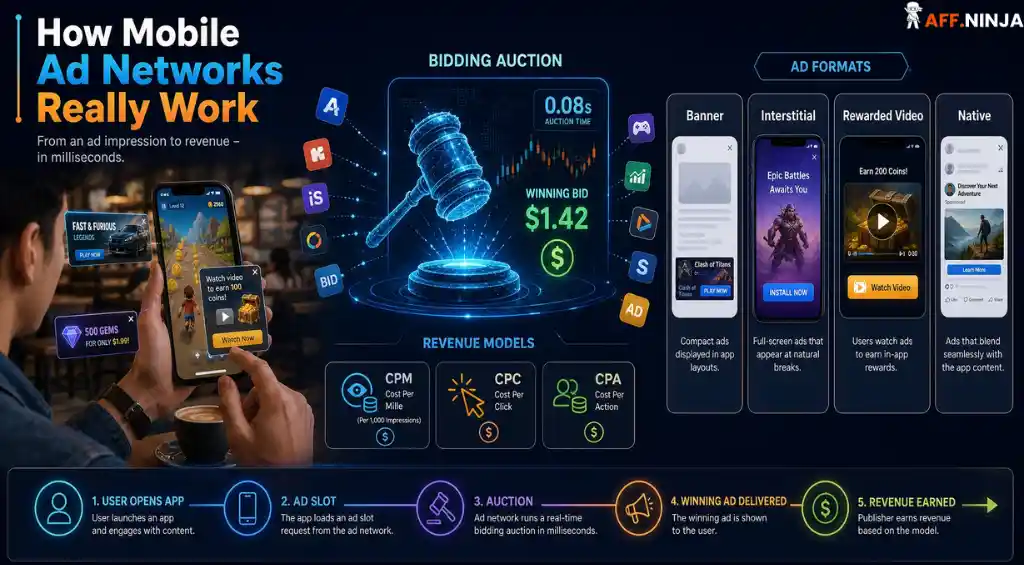
A mobile ad network is a platform that connects app publishers with advertisers looking to reach mobile users. It acts as the middleman, matching available ad space inside apps with brands or performance marketers who want to buy that space.
The process works through real-time bidding or fixed pricing. When an app opens an ad slot, the network's system auctions it off in milliseconds to the highest-paying advertiser, then delivers the winning ad instantly.
Most mobile ad networks support several core formats:
Publishers earn revenue based on impressions, clicks, or installs, depending on the pricing model the network uses — CPM, CPC, or CPA. Advertisers, meanwhile, get access to targeted audiences across thousands of apps without negotiating deals individually.
Understanding this mechanism matters because it directly affects fill rates, payout speed, and ad quality — the exact factors that separate a strong mobile ad network from a mediocre one, which the next section breaks down in detail.
How AFFNINJA Ranks the Best Mobile Ad Networks
At AFFNINJA, we evaluate mobile ad networks using real-world performance metrics rather than relying on promotional brochures. Identifying the right platform requires looking past surface-level promises to see how they actually behave under live campaign conditions.
We rank these networks based on four critical pillars:
By testing these platforms across various niches, we filter out underperformers. This rigorous approach ensures our recommendations can handle high-volume traffic while protecting your bottom line. Next, we will explore the specific types of ads these platforms deliver.
10 Best Mobile Ad Networks for Publishers and Advertisers
| Best Mobile Ad Networks | Best For | Key Strength |
|---|---|---|
| Google AdMob | App beginners | Google demand pool |
| Meta Audience Network | Social apps | Lookalike targeting |
| Unity Ads | Gaming apps | Unity SDK integration |
| AppLovin MAX | Multi network mediation | AXON ML bidding |
| InMobi | Emerging markets | AI audience segments |
| Adsterra | Affiliate traffic | High fill rate |
| PropellerAds | Utility apps | AI optimization engine |
| Mintegral | Creative testing | Programmatic scaling |
| Pangle | TikTok linked apps | ByteDance ad demand |
1. Google AdMob

Google AdMob is one of the most widely used mobile ad networks, built by Google to help app developers monetize through in app advertising. It connects publishers directly with Google's advertiser demand pool, running interstitial, banner, native, and rewarded video formats inside Android and iOS apps.
The platform works through real time bidding combined with mediation, letting developers set eCPM floors so ads only serve above a minimum value. This makes it a strong entry point for beginners exploring mobile ad networks since setup requires no upfront cost.
AdMob suits publishers who want a Google backed system with global fill rates, though smaller apps in low tier regions sometimes see thinner banner revenue.
| Attribute | Detail |
|---|---|
| Pricing model | Free to integrate, revenue share based. |
| Ad formats | Banner, interstitial, native, rewarded video. |
| Minimum payout | $100. |
| Payment methods | Bank transfer, PayPal, other alternative methods. |
| Average US eCPM (rewarded video) | $16.49 to $19.63. |
Google AdMob Pros and Cons
- Backed by Google's massive advertiser demand.
- Free integration with no setup cost.
- Strong rewarded video eCPM in US.
- Detailed reporting and eCPM floor controls.
- $100 minimum payout threshold applies.
- Banner ad eCPM stays comparatively low.
Why Choose Google AdMob?
Best for developers wanting a reliable, globally trusted mobile ad network with strong rewarded video payouts and easy Google Ads integration.
2. Meta Audience Network
Meta Audience Network extends Meta's advertising demand from Facebook and Instagram into third party mobile apps, making it a major player among mobile ad networks. It uses SDK integration to bring native, banner, interstitial, and rewarded video ads directly into app inventory.
Publishers benefit from Meta's core demographic and lookalike audience targeting, which draws on data from over 1 billion monthly ad viewers. This depth of targeting helps advertisers run efficient app install and ROAS focused campaigns across platforms.
The network works well for apps with a broad user base wanting consistent cross platform performance measurement.
| Attribute | Detail |
|---|---|
| Ad formats | Native, banner, interstitial, rewarded video. |
| Targeting | Core demographics, lookalike, interest based audiences. |
| Pricing model | CPM based. |
| Minimum payout | $100. |
| Payment schedule | Monthly payments. |
Meta Audience Network Pros and Cons
- Access to massive Meta advertiser demand.
- Strong lookalike and interest based targeting.
- Reliable monthly payment schedule.
- Consistent cross platform performance measurement.
- Requires Meta Business account setup.
- Performance tied closely to Meta policies.
Why Choose Meta Audience Network?
Ideal for social engagement apps wanting deep audience targeting and steady monthly payouts through an established advertiser ecosystem.
3. Unity Ads

Unity Ads operates as a mobile ad network purpose built for game developers using the Unity engine, though it also supports non Unity apps through SDK integration. It focuses heavily on rewarded video and interstitial formats that fit naturally within gaming experiences.
The network's machine learning driven bidding system matches ad inventory with advertisers seeking high engagement gaming audiences. Because it was built alongside the Unity development ecosystem, integration tends to be smoother for teams already using Unity's tools.
Developers outside gaming can still use Unity Ads, but its real strength lies in mobile game monetization workflows.
| Attribute | Detail |
|---|---|
| Ad formats | Rewarded video, interstitial. |
| Best suited for | Mobile game developers using Unity engine. |
| Integration | SDK based, deep Unity engine compatibility. |
Unity Ads Pros and Cons
- Seamless SDK integration for Unity games.
- Strong rewarded video performance in gaming.
- Machine learning driven ad matching.
- Best results limited mostly to gaming apps.
- Less optimized for non gaming publishers.
Why Choose Unity Ads?
Best suited for game studios already building in Unity engine who want tightly integrated rewarded video monetization.
4. AppLovin MAX
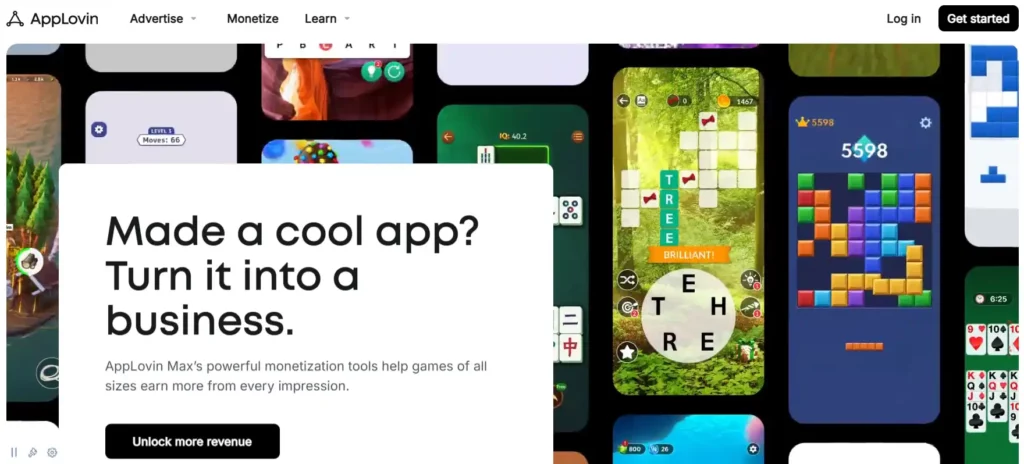
AppLovin MAX functions as an in app ad mediation platform rather than a single demand source, letting publishers run multiple mobile ad networks through one unified auction. It uses real time bidding data to maximize revenue across every connected network simultaneously.
Behind MAX sits AXON, AppLovin's proprietary machine learning engine launched in 2023, which helps advertisers scale user acquisition campaigns more efficiently. The platform also includes AppDiscovery for automated audience targeting and Adjust for campaign analytics.
Publishers running mediation across several mobile ad networks often choose MAX to consolidate reporting and auction dynamics in one dashboard.
| Attribute | Detail |
|---|---|
| Ad formats | Interstitial, video, rewarded, playable ads. |
| Core technology | AXON machine learning engine. |
| Targeting | Device, screen, app usage, geographic, demographic. |
| Analytics | Adjust integration for campaign tracking. |
AppLovin MAX Pros and Cons
- Unified mediation across multiple ad networks.
- AXON machine learning boosts campaign scaling.
- Strong performance in mobile gaming sector.
- Pricing structure varies by performance model.
- Setup complexity higher than single network SDKs.
Why Choose AppLovin MAX?
Suited for publishers running multiple mobile ad networks who need one mediation layer with machine learning optimized auctions.
5. InMobi

InMobi operates as a full stack mobile advertising platform combining a demand side platform, global supply marketplace, and publisher SDK into one ecosystem. This structure positions it among mobile ad networks that serve both large brand advertisers and performance focused publishers.
The platform applies AI and machine learning algorithms across 1,500 plus audience segments built from carrier and SDK level data, aiming to deliver more relevant ad experiences. Formats span HTML display, MRAID rich media, video, native, and playable ads.
InMobi has strong presence in Asia and African markets, making it a practical choice for publishers targeting emerging region traffic.
| Attribute | Detail |
|---|---|
| Ad formats | HTML display, MRAID, video, native, playable. |
| Pricing model | dCPM based. |
| Payout timeline | 60 day payout cycle. |
| Minimum payout | $300 via wire, $50 via PayPal. |
| Regional strength | Asia and Africa markets. |
InMobi Pros and Cons
- Full stack DSP and SDK ecosystem.
- 1,500 plus AI powered audience segments.
- Strong presence in emerging markets.
- 60 day payout cycle is lengthy.
- $300 minimum threshold for wire transfer.
Why Choose InMobi?
Fits publishers targeting emerging markets who want AI driven segment targeting across a full stack advertising ecosystem.
6. Adsterra

Adsterra positions itself among mobile ad networks that emphasize flexible traffic monetization across diverse ad formats and geographies. It supports popunder, native, banner, and video ad types designed to accommodate different publisher traffic profiles.
The network is frequently mentioned for offering a near complete fill guarantee, meaning most ad requests get filled with paying advertisers rather than going unmonetized. This appeals to publishers running mixed traffic types who want consistent revenue rather than gaps in fill rate.
Adsterra tends to attract performance marketers and affiliate publishers working across broader traffic sources beyond conventional app store audiences.
| Attribute | Detail |
|---|---|
| Ad formats | Popunder, native, banner, video. |
| Traffic focus | Diverse traffic types across multiple verticals. |
| Notable strength | High fill rate guarantee. |
Adsterra Pros and Cons
- Strong fill rate across diverse traffic.
- Multiple ad formats for flexible use.
- Works well for affiliate style traffic.
- Less specialized for app store gaming.
- Traffic quality varies across regions.
Why Choose Adsterra?
Good fit for publishers with mixed or affiliate traffic seeking dependable fill rates across varied ad formats.
7. PropellerAds

PropellerAds is known among mobile ad networks for its AI driven optimization system that adjusts targeting and bidding based on live campaign performance data. It supports formats built for utility apps and performance marketing niches rather than pure gaming inventory.
The network's self serve platform lets advertisers launch campaigns quickly while its optimization engine continuously refines audience delivery. Publishers running utility or niche category apps often find PropellerAds better aligned with their traffic than gaming focused networks.
Its broad reach across many countries makes it a practical option for publishers with international audiences.
| Attribute | Detail |
|---|---|
| Best suited for | Utility and niche category apps. |
| Core strength | AI driven optimization engine. |
| Platform type | Self serve advertiser dashboard. |
PropellerAds Pros and Cons
- AI driven optimization improves targeting accuracy.
- Strong fit for utility category apps.
- Broad international traffic coverage.
- Less focused on premium gaming inventory.
- Self serve setup requires manual tuning.
Why Choose PropellerAds?
Works well for utility app publishers wanting AI optimized targeting rather than gaming specific ad formats.
8. Mintegral
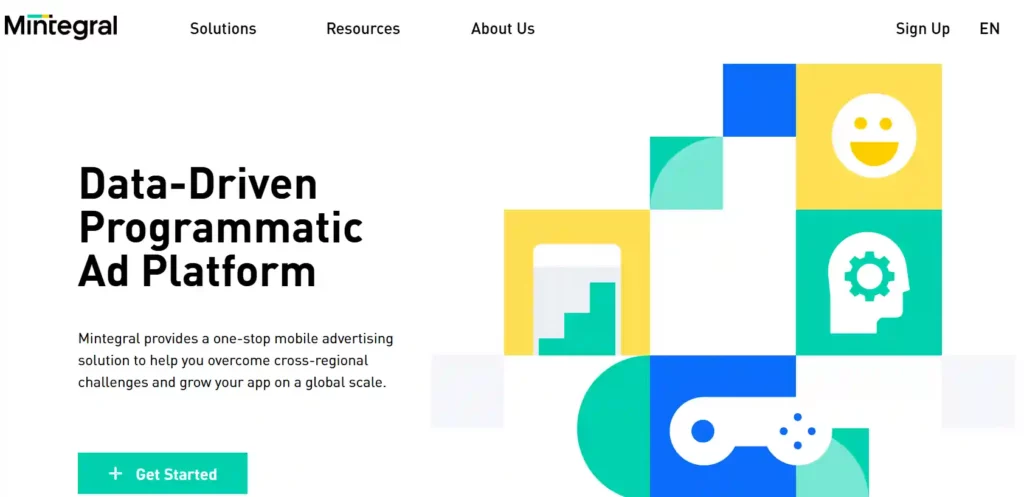
Mintegral operates as a mobile ad network with a particular focus on programmatic advertising and creative optimization for mobile game and app advertisers. It provides tools for advertisers to test and optimize creative assets across multiple ad formats.
The platform emphasizes global reach with a notable presence in emerging markets, giving advertisers access to audiences that some Western focused networks cover less thoroughly. Publishers integrate Mintegral through SDK based mediation setups similar to other major networks in this list.
Its programmatic infrastructure appeals to advertisers running performance campaigns that depend on creative testing at scale.
| Attribute | Detail |
|---|---|
| Core focus | Programmatic advertising and creative optimization. |
| Integration | SDK based mediation. |
| Regional strength | Emerging market coverage. |
Mintegral Pros and Cons
- Strong creative testing and optimization tools.
- Solid coverage across emerging markets.
- Programmatic infrastructure suits scaled campaigns.
- Less established brand recognition globally.
- Documentation less detailed than larger networks.
Why Choose Mintegral?
Suited to advertisers focused on creative testing and programmatic scaling across emerging market mobile traffic.
9. Pangle

Pangle is the mobile ad network operated by ByteDance, the parent company of TikTok, giving it access to demand tied to the broader ByteDance advertising ecosystem. It supports standard mobile formats including rewarded video, interstitial, and native ads within third party apps.
Because of its ByteDance ownership, Pangle often carries strong demand density in regions where TikTok and related apps have high penetration. Publishers integrating Pangle typically do so through mediation platforms alongside other mobile ad networks to diversify demand sources.
This network fits publishers wanting exposure to ByteDance linked advertiser budgets outside the traditional Google or Meta ecosystems.
| Attribute | Detail |
|---|---|
| Parent company | ByteDance. |
| Ad formats | Rewarded video, interstitial, native. |
| Integration | Typically used within mediation stacks. |
Pangle Pros and Cons
- Access to ByteDance advertiser demand pool.
- Strong regional density in TikTok markets.
- Works alongside other mediation partners.
- Smaller standalone demand outside key regions.
- Less transparent public documentation available.
Why Choose Pangle?
Best for publishers wanting to diversify demand sources by tapping into ByteDance linked advertiser budgets alongside existing networks.
Ad Formats Supported by Top Mobile Ad Networks
The profitability of a mobile app relies heavily on choosing the right ad formats for your audience. Top mobile ad networks provide a variety of creative options designed to balance user experience with high conversion rates.
Matching the right format to your app's interface prevents user churn while maximizing ad engagement. The most common formats include:
Selecting the appropriate format directly influences user retention and interaction. Once the formats are locked in, the next step is understanding how these networks calculate your earnings.
Mobile Ad Network Pricing Models Explained (CPM vs CPC vs CPA)
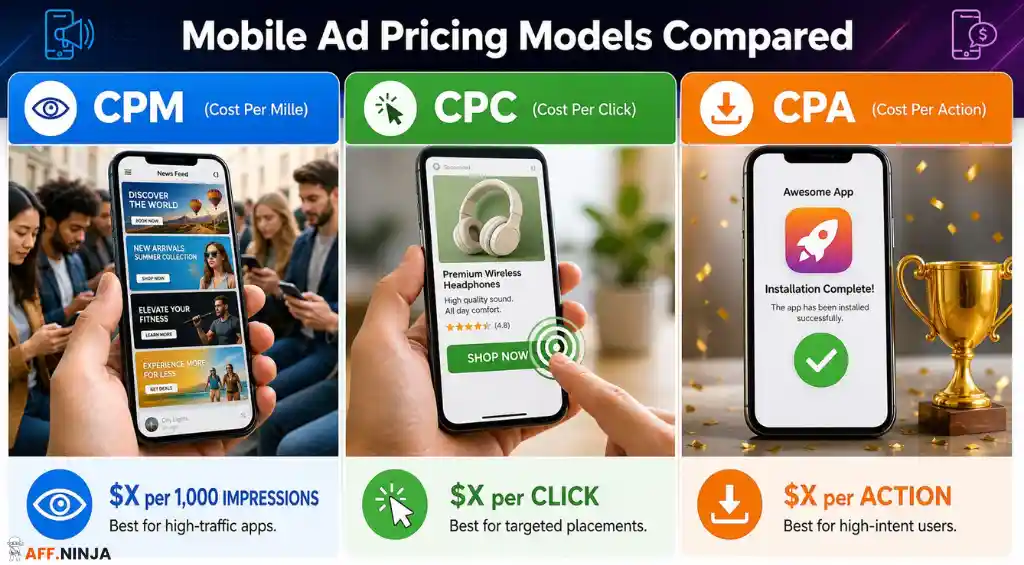
Mobile ad networks use different pricing models to determine how advertisers are charged and how publishers get paid. Understanding these structures is essential for projecting revenue and aligning your monetization strategy with user behavior.
The right model depends on whether your app generates high traffic volume, high engagement, or deep user intent. The three primary models are:
Choosing the correct pricing framework ensures your ad space is monetized efficiently based on your specific traffic type.
Would you like me to draft the 10 specific mobile ad network reviews next, or focus on the comparison table?
AFFNINJA's Take on Mobile Ad Networks
Every mobile ad network brings its own strengths, from Google's massive reach to InMobi's presence in emerging markets. What matters most is how each platform fits your app's audience, traffic type, and long term revenue goals.
Payout terms, ad formats, and targeting depth all shape real world performance far more than marketing claims ever do. A network that works well for gaming apps might fall short for utility or social platforms, and that difference becomes clear once you look past surface level promises.
Take time to test, compare, and observe how each platform behaves with your own traffic. Clarity tends to come from experience, not assumptions.
Dominate Affiliate Marketing like the Top 1% Earners
Join 69,572+ winning affiliates in our exclusive newsletter packed with
proven strategies, tools, and secrets to skyrocket your success.
Affiliate Disclosure: This post may contain some affiliate links, which means we may receive a commission if you purchase something that we recommend at no additional cost for you (none whatsoever!)